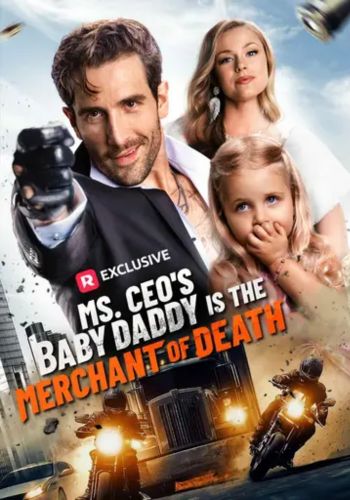

He runs the world's biggest arms empire from a truck seat
Advertisements
She tracked him down with a daughter, a DNA test, and zero patience left
Dominion Tech is not the kind of company that appears in news cycles or shareholder reports. It operates through controlled channels, sells to clients who do not advertise their purchases, and is worth more than most governments spend on defense in a year. Connor Reed built it into what it is, and he runs it with the kind of authority that comes from knowing exactly how much force any situation requires. When someone inside that world decides Connor needs to be removed, he does not go to the police or hire additional security. He goes invisible. He trades in his identity for a commercial truck license and a route that keeps him moving through states where no one is looking for the most powerful arms dealer alive.
Scarlett Hayes was not supposed to be part of any of this. She is flagging down a truck on a highway at night because her situation has deteriorated past the point of better options, and Connor pulls over because he reads people for a living and she is not a setup. The hours that follow are not something either of them plans. A real current runs between two people who have both spent years operating alone, and for one night that current finds somewhere to go. Connor is gone before sunrise. He has reasons, all of them valid, none of them the kind he can explain to a stranger. Scarlett watches taillights disappear and goes back to her life.
That life gets harder before it gets easier. Scarlett is the CEO of the Hayes family company in the way that a person can hold a title and still be treated as an outsider — tolerated when useful, attacked when inconvenient. Her stepmother runs the family's social architecture like a long campaign, and Scarlett's younger half-sister has learned to use that architecture against her. When Scarlett's pregnancy becomes impossible to conceal, her father's response is to demand she give up the child and accept an arranged marriage to the Whitmore family, which would at least make the Hayes name look clean again. Scarlett refuses without drama. She does not need their version of a solution. She raises Summer alone, keeps her position, and spends four years watching her daughter grow up in a house where the word fatherless gets used like a verdict.
Finding Connor required the kind of methodical patience that most people abandon when results do not come quickly. Scarlett did not abandon it. By the time she walks up to him in a truck stop parking lot with Summer at her side, she has done the work, verified the facts, and prepared for resistance. She is not there to reminisce. She lays out what she knows, what she can prove, and what she expects him to do about it. Connor, who has neutralized threats on four continents, stands in front of a four-year-old girl who looks at him with complete recognition and calls him by a name he has never been called before. The DNA test that follows is a formality. The fast marriage that comes after is a negotiation. What neither of them anticipated is that living in the same space as another person, day after day, changes the terms of every agreement you thought you had made.
The series earns its tension from a credible reversal: Connor is introduced as a man for whom control is a baseline condition of survival, then placed inside a domestic and corporate situation where his usual instruments do not apply. He cannot buy the Hayes family into treating Scarlett differently. He cannot eliminate the organizational threats to her company with the directness he would use in his own world. He has to operate inside constraints that are new to him while maintaining a cover that protects everyone around him. Scarlett, meanwhile, is adjusting to a partner who appears from nowhere, brings resources she cannot fully account for, and refuses to explain the parts of himself that would make sense of the rest. The discomfort between them is written as genuine friction, not manufactured conflict, and that distinction shows.
What ReelShort's format demands from its best series is a story architecture that holds together across dozens of very short episodes without losing its shape or running out of forward motion. This series meets that demand through a structure that keeps two separate conflict tracks running at different speeds. The family antagonist plot escalates on a domestic timeline. The arms-dealer danger plot operates on a different rhythm entirely, surfacing when it can do the most structural damage to whatever stability Connor and Scarlett have managed to build. The writers use the gap between those two rhythms deliberately, and the result is a series that does not feel stretched across its episode count but genuinely builds across it.
Rachel Monroe is a drama critic with deep expertise in Korean and Chinese productions. She brings a screenwriter's eye to her analysis, breaking down story structure, dialogue, and the emotional beats that make K-Drama and C-Drama so compelling. Her work helps Western audiences navigate and appreciate Asian storytelling traditions.
All content published on this page exists for informational and entertainment purposes only. Ownership of Ms. CEO's Baby Daddy Is the Merchant of Death, including all copyrights, trademarks, and distribution rights, belongs entirely to the original producers and the ReelShort platform. Viewers who want to watch the complete series are encouraged to use ReelShort's official app or website, where the production team receives proper credit and compensation for their work. This site operates as an independent editorial publication focused exclusively on critical coverage of short-form drama content. All reviews and recommendations published here are free to read. We collect no fees, require no payment information, and operate no subscription model of any kind. We do not host or distribute any video content. Our function is to provide honest critical analysis that helps audiences decide what is worth their time. To watch Ms. CEO's Baby Daddy Is the Merchant of Death in full and support the people behind its production, please access the series through ReelShort's official platforms.